

Beech Leaf Disease (BLD)
Beech Leaf Disease was first discovered in the U.S.A. in 2012 and has since quickly spread. It entered Ontario in 2017 and has continued to spread across the range of American Beech (Fagus grandifolia).
Research into the spread of BLD is ongoing but it is believed to be contained in an invasive nematode (Litylenchus crenatae ssp. Mccannii) that is found in the buds and leaves of Beech trees. BLD displays only on leaves and buds and shows as striping on the leaves. This infection can lead to curling of leaves and early defoliation of leaves. Long term infection leads to reduced bud and leaf production.
BLD is observed easiest in sapling stage trees in the understory of forests. These infected trees are hindered and will struggle to reach maturity, impacting the Beech representation on the landscape as well as making the Beech trees more susceptible to other pets and pathogens.
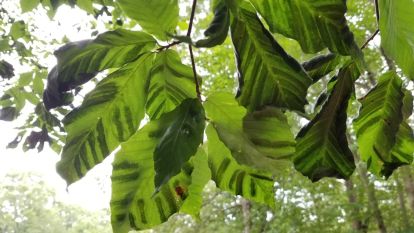
American Beech (Fagus grandifolia) leaves backlit showing the dark striping of Beech Leaf Disease. Photo credit Heather Faubert, University of Rhode Island.
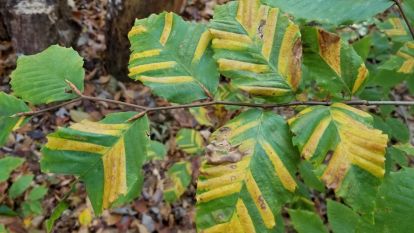
American Beech (Fagus grandifolia) tree infected with Beech Leaf Disease observed in fall. Photo credit Heather Faubert, University of Rhode Island.
More Information